Senior living communities depend on technology every day. Residents use television and Wi-Fi to stay entertained and connected, while staff rely on IT infrastructure, phone systems, and nurse call technology to support daily operations.
But these services often come from different providers. One company handles television, another manages Wi-Fi, and separate vendors look after IT, phones, and nurse call systems. Each may do its job well, but managing all those relationships can become complicated.
Could working with a senior living technology partner make things easier? By bringing appropriate services under one coordinated relationship, communities can simplify support, improve communication, and reduce the administrative burden on their teams.
“Senior living communities need technology they can depend on, backed by support they can trust. At CSS, our focus is on simplifying technology management and building lasting partnerships.”
Why Do Senior Living Communities Use Multiple Technology Vendors?
Most communities do not deliberately choose to work with five different technology providers. Their vendor relationships usually develop over time.
A community might start with one provider for television. Later, it needs property-wide Wi-Fi, so it brings in another company. As its requirements grow, it may add managed IT, phone systems, and nurse call technology.
Acquisitions, existing contracts, and differences in provider capabilities can also contribute to fragmented arrangements.
The challenge is not necessarily that every system is unreliable. It is that managing the relationships between them takes time.
For example, a network issue might affect more than one service. Staff may need to contact several providers, explain the same problem repeatedly, and work out who is responsible for resolving it.
Without clear accountability, even a straightforward technical issue can involve unnecessary back-and-forth.
The Hidden Cost of Managing Five Separate Vendors
Technology expenses are relatively easy to identify. Communities can review invoices, contract terms, renewal dates, and service charges.
The administrative cost of managing multiple providers is harder to measure. It includes time spent contacting support teams, following up on unresolved issues, arranging site visits, and coordinating installations.
For executive directors, maintenance teams, and operations leaders, these tasks compete with responsibilities that directly support residents and employees.
Some common challenges include:
- Unclear accountability: When an issue affects multiple systems, providers may investigate only their individual services. Community staff can end up coordinating the troubleshooting.
- Different support processes: Each provider may have its own help desk, escalation procedure, and response expectations.
- Separate contracts and billing: Multiple agreements mean more invoices, renewal dates, and service terms to oversee.
- Inconsistent service across locations: Different providers and local arrangements can make it harder for multi-community operators to maintain consistent support.
- More coordination during upgrades: Installing or replacing one system can affect other services, requiring communication between several technical teams.
This is why vendor consolidation senior living operators consider it to be about more than reducing invoices. The real objective is to make technology easier to oversee.
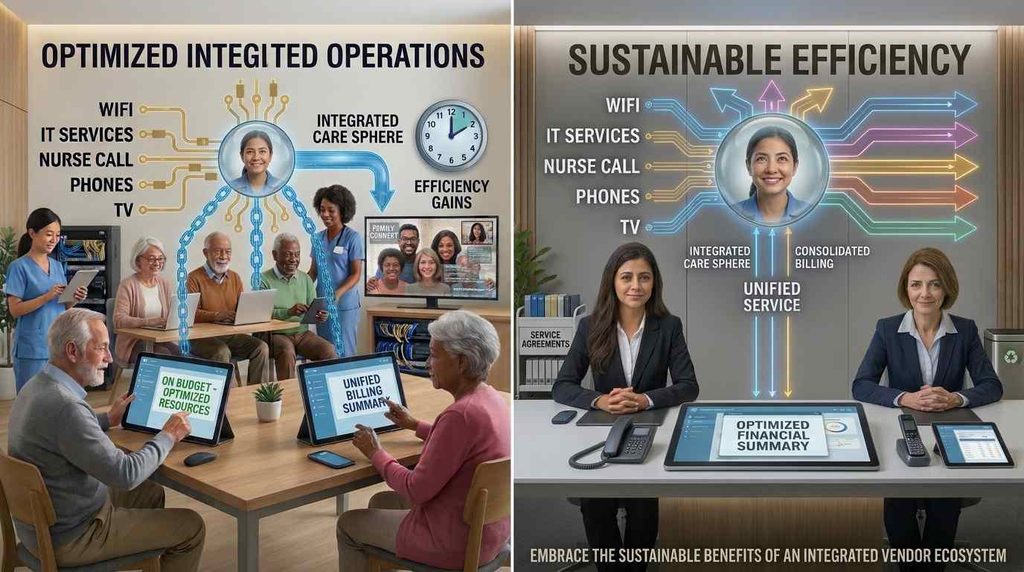
One Technology Partner Vs. Five Separate Vendors
Managing technology across multiple vendors can create additional coordination work, particularly when responsibilities, support processes, and communication are not clearly defined. A single technology partner may offer a more coordinated approach, depending on the services provided and the agreement in place. Here is how the two approaches compare.
| Area | Five Separate Vendors | One Coordinated Technology Partner |
| Communication | Multiple contacts and support teams may be involved. | A more centralized point of contact may simplify communication. |
| Accountability | Responsibilities may be distributed across providers. | Responsibility may be clearer for services covered by the agreement. |
| Support | Different help desks and escalation processes may apply. | Support may follow a more coordinated process. |
| Billing | Separate invoices and service agreements. | Potentially consolidated billing. |
| Service Management | Individual providers manage their respective systems. | Multiple services may be managed through one provider relationship. |
| Multi-Community Operations | Service arrangements may vary across locations. | Greater opportunity to standardize services across communities. |
| Installations | Coordination may be needed between multiple providers. | Installation coordination may be simpler when services fall within the provider’s scope. |
Note: These are potential differences, not guaranteed outcomes. Actual arrangements depend on the provider’s capabilities, service agreements, and the community’s existing systems.
What Does Industry Research Tell Us About Technology Challenges?
Technology fragmentation is not just an operational concern for individual communities. Industry research also highlights the challenges of making different systems work together.
The 2025 Argentum Technology Report identified interoperability as a major barrier to technology implementation in senior living.
According to the report:
- 77% of surveyed senior living executives ranked interoperability among their top three technology implementation and management challenges.
- 74% ranked compatibility with existing infrastructure and devices among their top three challenges.
These findings show why communities need to consider how new technology fits into their existing environment. A system may work well on its own but still create difficulties if it does not work effectively alongside other services.
The report does not suggest that using fewer vendors automatically solves interoperability. It reinforces the importance of compatibility, communication, and collaboration when choosing technology providers.
Source: 2025 Argentum Technology Report.
What Are the Benefits of Consolidating Senior Living Technology Vendors?
Bringing appropriate services under one provider relationship can make technology oversight more manageable. It does not mean replacing every system or forcing all services into one platform.
Instead, it means reducing unnecessary fragmentation and establishing clearer responsibility for the services a provider manages.
Potential benefits include:
Clearer communication and accountability
Staff have a more direct support relationship for services covered by the agreement. Responsibilities and escalation procedures can also be established more clearly.
Less administrative work
Fewer separate relationships can mean fewer contacts, invoices, renewal dates, and support processes to manage.
More consistent support across locations
Multi-community operators can work toward common service expectations and support processes across their properties.
Better coordination during installations
When a provider manages several services, its teams may be better positioned to coordinate related installation activities and reduce unnecessary disruption.
Greater visibility into technology costs
Consolidated agreements can make it easier to review service expenses and identify opportunities to simplify spending.
These benefits depend on the provider’s capabilities and the terms of the agreement. Communities should confirm which services are covered and how issues involving outside systems will be handled.
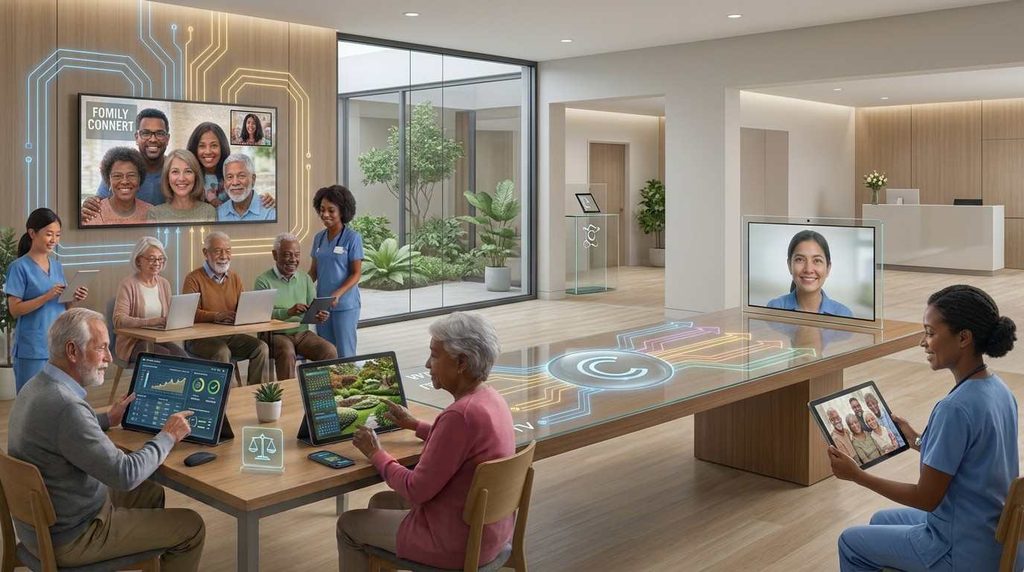
Which Senior Living Technology Services Can One Provider Manage?
A senior living technology partner may be able to manage several essential services through one coordinated relationship. The right combination depends on the community’s requirements and existing infrastructure.
These services may include:
DIRECTV and resident entertainment
Television remains an important part of the resident experience. CSS supports DIRECTV for senior living communities, with services designed around the needs of senior living properties.
Property-wide Wi-Fi
Reliable connectivity supports residents, visitors, and staff. CSS provides managed WiFi solutions for senior living to help communities address connectivity needs across their properties.
Managed IT services
IT infrastructure supports many daily operations. Having an experienced provider manage agreed IT services can help communities maintain their systems and address technical issues.
Nurse call systems
Nurse call technology supports communication between residents and care teams. Communities can explore nurse call technology for senior living as part of a broader technology approach.
Business and resident phone systems
Phone services remain essential for communication between staff, residents, families, and external contacts. Coordinating these services with other technology requirements can simplify oversight.
Not every provider manages all these services directly. Communities should check service capabilities, system compatibility, and support responsibilities before consolidating agreements.
A Real-World Example: Simplifying Technology Across 109 Communities
CSS’s Freit Management customer success story shows how consolidation can help multi-community operators.
The organization was managing more than 100 cable agreements. Keeping track of separate arrangements made costs, service quality, and support more difficult to oversee.
CSS helped standardize DIRECTV across 109 communities, bringing billing and support under a centralized arrangement.
This gave the organization a more consistent approach to television service and a centralized support contact.
The example demonstrates a practical benefit of consolidation: instead of managing more than 100 separate cable agreements, the organization could oversee its television service through a more coordinated arrangement.
It is important to be precise about the results. This case study concerns DIRECTV standardization, billing, and support. It does not mean that all five technology categories were consolidated for this customer.
For multi-community operators, however, the lesson is relevant. Standardizing services across locations can reduce administrative complexity and make technology easier to oversee.
What Does a Customer Say About Working with CSS?
The quality of a technology relationship matters just as much as the services a provider offers. Communities need responsive communication, practical solutions, and support that continues beyond installation.
Garry Leonas shared his experience in a Google review displayed on CSS’s senior living website. At the time of his review, his organization had worked with CSS for just over three years, with CSS serving more than 30 of its senior living communities.
He highlighted the company’s communication, budget-conscious solutions, installation coordination, and ongoing support.
One part of his review captures the value of that relationship: “CSS is more than just a vendor, they are a partner working with us side by side.”
Garry Leonas, Google review displayed on CSS’s website.
This testimonial reflects our customer’s experience and highlights the importance of responsive support, clear communication, and a long-term technology relationship. It is one customer’s perspective, not a guarantee that every community will have the same experience.
How to Choose the Right Technology Partner for Your Community
Consolidating vendors is not automatically the right decision in every situation. Communities should first establish whether a provider can genuinely support their requirements.
Before making a change, consider:
- Senior living experience: Does the provider understand resident needs, staff responsibilities, and the importance of minimizing disruption?
- Service capabilities: Can it manage the services you want to consolidate, or will separate specialists still be required?
- Clear responsibilities: Who handles support requests, and how are issues escalated?
- Existing infrastructure: Can the provider work with current equipment where appropriate?
- Transparent costs: Are installation charges, recurring fees, equipment, and contract terms clearly explained?
- Multi-community support: Can the provider maintain consistent service across different locations?
A good senior living technology partner should understand the community’s current environment before recommending changes. The goal is not to consolidate for the sake of having fewer vendor names. It is to create a more manageable technology operation.

Less Vendor Complexity, More Time for Residents
Senior living communities cannot afford to treat technology as a collection of unrelated services. Television, connectivity, communications, IT, and nurse call systems all contribute to daily operations and the resident experience.
A more coordinated approach to technology management for senior living can simplify communication, improve visibility, and make essential services easier to oversee.
At CSS, the focus is on helping communities bring DIRECTV, Wi-Fi, managed IT, nurse call, and phone services together through one provider relationship. This is the value of integrated senior living technology: coordinating appropriate services while considering how they fit into existing operations.
CSS also provides senior living IT services as part of its broader offering. The right combination will depend on each community’s systems, needs, and support requirements.
If your team is managing multiple technology providers, it may be time to review where those relationships overlap and where a simpler approach could help.
Ready to simplify your community’s technology? Discuss your community technology needs with CSS and explore a solution built around your residents and operations.
Frequently Asked Questions
1. What does a technology partner do for a senior living community?
A technology partner helps a community manage agreed technology services. Depending on its capabilities, this may include television, Wi-Fi, IT, phone systems, and nurse call technology, along with installation and ongoing support.
2. Why do senior living communities have separate technology contracts?
Technology needs often develop over time. Communities may select different providers for individual services, inherit agreements through acquisitions, or retain existing contracts because they meet specific requirements.
3. Can consolidating vendors reduce technology costs?
It can create opportunities to simplify billing, review overlapping services, and improve visibility into spending. Actual savings depend on existing contracts, service requirements, and the provider’s pricing.
4. Does vendor consolidation mean replacing existing systems?
Not necessarily. A provider may be able to work with existing equipment and infrastructure where appropriate. Communities should review compatibility and replacement requirements before making changes.
5. Can one provider support multiple senior living communities?
Some providers can support multi-community operators through standardized services, centralized billing, and coordinated support. Communities should confirm the provider’s capacity and service arrangements.
6. What should communities check before signing a technology agreement?
Review service coverage, support hours, escalation procedures, installation costs, recurring charges, contract terms, and responsibilities for systems managed by outside providers.
7. How can communities make technology easier for staff to manage?
Start by reviewing existing providers, contracts, support processes, and recurring issues. Identify where responsibilities overlap and whether bringing appropriate services under a coordinated provider relationship would reduce administrative work.